4 Day All Inclusive Arenal Escape
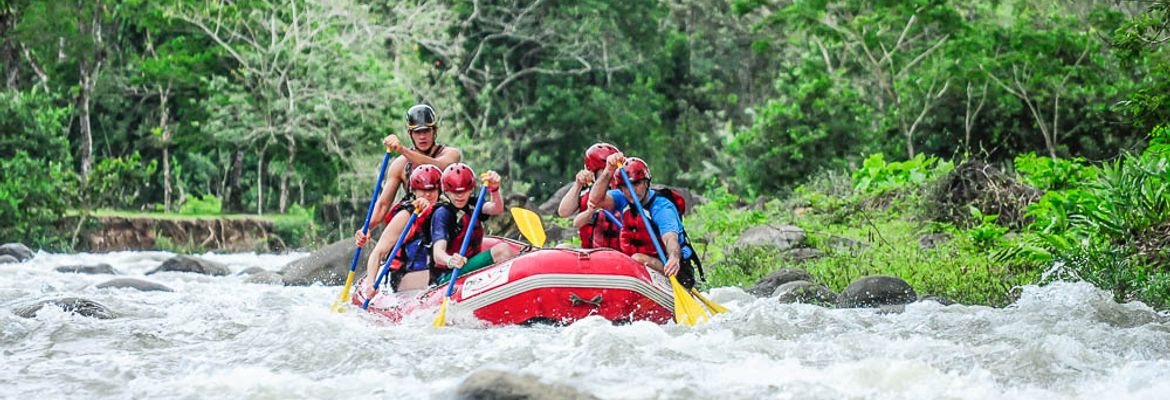
Explore the wilds of Costa Rica on a three night/four day all-inclusive adventure set below the slopes the Arenal Volcano. Spend your days plunging into the temperate natural spring waters of a Costa Rican river on a whitewater rafting or safari tour, rappelling down waterfalls in Lost Canyon and choosing from a list of local activities including hiking, kayaking and zip lining.
Features
- Choose one: Class II-III rapids on the Balsa River, Class III-IV on the Toro River, or Safari float down the Peñas Blancas River
- Lost Canyon waterfall rappelling with a buffet-style lunch
- Choose one: Kayak or Stand Up Paddle at Lake Arenal, hike in Arenal Volcano National Park, zipline in the rainforest, or explore the Venado Caverns
- Visit to a natural hot spring resort with a buffet-style dinner
Highlights
- 3-night standard accommodations in Arenal
- Hotel taxes
- Ground transportation from/to Juan Santamaria airport in Alajuela
- 8 meals: 3 breakfasts, 2 lunches & 3 dinners
- Services of local bilingual guides
- Entrance fees per itinerary
Local Weather
Local Weather
Month | Average Highs | Average Lows | Average Rainfall | Humidity | |||
|---|---|---|---|---|---|---|---|
| F | C | F | C | in. | mm | % |
Jan. | 83 | 28 | 68 | 20 | 7.48 | 192 | n/a |
Feb. | 84 | 29 | 67 | 20 | 5.14 | 132 | n/a |
Mar. | 86 | 30 | 69 | 20 | 3.58 | 92 | n/a |
Apr. | 87 | 31 | 69 | 21 | 3.7 | 95 | n/a |
May | 88 | 31 | 70 | 21 | 10.23 | 262 | n/a |
Jun. | 86 | 30 | 71 | 22 | 16.15 | 414 | n/a |
Jul. | 85 | 30 | 71 | 22 | 19.87 | 509 | n/a |
Aug. | 85 | 30 | 72 | 22 | 17.05 | 437 | n/a |
Sep. | 86 | 30 | 70 | 21 | 16.07 | 412 | n/a |
Oct. | 85 | 30 | 70 | 21 | 16.98 | 435 | n/a |
Nov. | 83 | 29 | 71 | 22 | 12 | 308 | n/a |
Dec. | 82 | 28 | 70 | 21 | 10.1 | 259 | n/a |
Source: National Weather Services of Costa Rica
Attractions
Attractions
Arenal Volcano
Over the last 40+ years, a second cone has grown up next to the previous, and today, Arenal has two twin volcanic peaks. The volcano's second peak is just a few feet taller than the first. Together they form the world-renowned "perfect" volcanic cone.
Arenal has had several names throughout the years, including Arenal Peak, Rio Frio Volcano and Pan de Azucar (Sugar Loaf). In Spanish, Arenal means "sand dune," and refers to the volcano's ash, or sandy slopes. Its cone is so perfect, that volcano aficionados have declared it the third-most best volcanic cone in the world. At just 3,000 years old, Arenal Volcano is considered a young volcano.
On July 29, 1968, Arenal Volcano violently awoke. For the first time in over 400 years, the volcano spewed its hot pyroclastic flow of gas, molten rock and ash. The eruption blew two holes in the western side of the volcano devastating the towns lay beneath, including Tabacon and the original Arenal. 80 people died in the ensuing destruction.
After the 1968 eruption, Arenal continued to erupt on a daily basis – a phenomenon known as strombolian activity. The volcano's lava, considered to be relatively cool, accumulated making the volcano to grow almost 10 feet per year.
Volcanologists in Costa Rica constantly monitor Arenal's activity and warn that the volcano could have a major eruption in the future.
Arenal Volcano National Park
Beyond the brave cane, small twisted trees, more fitting of a desert, grow out of the volcanic soil. Below them the tiny sprouts of touch-me-not plants, droop inward with the slightest brush of a hand or foot.
Rainforest covers more than a third of the 30,000 acre national park. While much of the original rainforest destroyed in Arenal volcano's 1968 eruption, parts survived –even when choked in volcanic ash. At certain places in the park, you can see where the trail separates the rainforest from the brave cane.
Deeper into the park, you'll encounter the remnants of the 1968 eruption's Lava flow; the broken pieces of lichen smeared volcanic badlands that reach up from the rainforest. Standing on top of the lava flow, you can see impressive views of Lake Arenal and the volcano.
Although it's too dangerous to actually walk up Arenal volcano (poisonous gas is always a deterrent), you can still enjoy more than five miles of trails through the parks many habitats including rainforest, grasslands and volcanic badlands.
First-time visitors to Arenal Volcano National Park may notice that one half of the volcano appears charred, black and barren while the other is layered in thick, primary rainforest. During the 1968 eruption, lava and molten rock demolished the western half of the volcano leaving behind ash-covered ground, igneous rock and giant craters from volcanic debris.
Weather:
Average Temperature: 75 to 90 degrees
Annual Rainfall: Up to 195 inches
Weather, as in much of Costa Rica, is unpredictable with clouds rolling in at a moment's notice, obscuring Arenal's near-perfect cone. Increase your odds with a visit during the dry season.
Activities:
Hikes and nature walks are the most popular activities in the park where experts estimate that approximately half of Costa Rica’s land-dwelling vertebrate species live.
Note that, for the safety of park guests, hiking is only permitted on marked trails. Additionally, due to the volcano’s toxic fumes and gases, visitors are not allowed to hike near the volcano's crater.
Camping is not permitted in Arenal Volcano National Park. The Arenal Observatory Lodge is located in the national park and is the only place visitors can legally sleep within the park's boundaries.
Flora & Fauna:
Hikers and wildlife watchers often see howler and spider monkeys, white-nosed coatis, sloths, deer, boa constrictors, parrots, parakeets, black vultures, resplendent quetzals, trogons, hummingbirds, and motmots. Plenty of interesting ferns, heliconia, match trees, brave cane and hardwoods dot the landscape as well.
Facilities:
A ranger station and restrooms are located at the entrance to the park. Trail maps are available at the ranger station.
Trails:
The park has four trails that span more than five miles through the park.
Heliconias Trail: This 0.6-mile loop trail is the ideal introduction to the park and volcano, as it passes by the 1968 lava flow site. The trail has access to a longer one-mile trail that leads to an overlook of the volcano and Lake Arenal.
Las Coladas Trail: Mostly flat, this 1.25-mile trail winds around the base of the volcano, offering views of the 1993 lava flows. This trail connects directly with the Toucans Trail.
Toucans Trail: Continues from the Las Coladas Trail another 1.8 miles through dense, tropical rainforest. This is a great place for spotting wildlife, especially howler and spider monkeys in the trees. On the way back to the park entrance (the trail does not loop, so hikers must double-back), enjoy excellent views of the volcano summit.
Lookout Trail: Accessed only from the park headquarters, the Lookout Trail leads down to Lake Arenal. Located at the base of the volcano, the trail offers great views of the 1968 and 1993 lava flows, as well as Cerro Chato and Arenal Basin.
Recommendations:
Light rain gear is advisable. Visitors can hike park trails on their own or join a guided hike available in La Fortuna.
Getting There:
From La Fortuna drive west toward Tabacon Resort and continue 1.2 miles until you see a sign for the national park. Turn left on the hard-packed dirt road, and then follow the signs to the park, which will be on the left.
A taxi costs approximately $50-60 round-trip from La Fortuna to the western part of the volcano. Buses are available twice a day, 8 a.m. and 2 p.m., cost $5.50, and leave from the La Fortuna bus station.
History:
At approximately 3,000 years old, Arenal Volcano is considered a young volcano. Little is known about its early life, but it had been believed dormant from AD 1500 until 1968. In fact, adventure lovers, hikers and naturalists regularly ascended to the volcano’s summit, often camping out in the cool crater.
On July 29, 1968, for the first time in recorded history, Arenal Volcano erupted. Lava and magma exploded from the volcano, turning its once-green slopes to dots of red and gray ash. Eighty people and approximately 45,000 cattle, in addition to countless wild animals, were killed in the eruption.
The 1968 eruption destroyed several towns, including the original Arenal. Today, those towns lie flooded beneath Lake Arenal, which was created in 1979. The largest lake in Costa Rica, the 21,128-acre reservoir provides almost 50% of Costa Rica’s total electricity, as well as water for farming and irrigation. Arenal Volcano National Park, which is adjacent to Arenal Lake, is an important watershed, providing over 70% of the lake’s water.
Interestingly, Arenal Volcano’s return to active status was not through the old crater – on July 29, lava erupted from three new craters, shooting out enough lava rock to begin creating a new cone beside the old crater. Today, Arenal Volcano’s second cone is a few feet taller than the first, and together, they form what is considered the third-most perfect volcanic cone in the world.
Baldi Hot Springs
Pools
Starting from the top of the hill beside the helipad, there are three waterslides that take guests through twists and turns at speeds up to 28mph. Guest land in the largest of Baldi's pools, where they can relax under the 360 degree waterfall in its center. Farther down the hill, you'll find a series of freeform landscaped caverns hiding steaming waterfalls and a natural sauna. The steaming waterfall then trickles down into Baldi's hottest pool – 113 degrees.
Jumping into the frothing bubbling giant jacuzzi, you'll see a series of waterfalls pouring down from freeform white cliffs. Inside you'll find seats with strong Jacuzzi jets that'll force the tension out of your lower back.
Of course there are also a variety of soaking pools perfect for relaxing or chatting with family and friends – each adorned with its own waterfall or unique feature like a cold pool or a hidden grotto.
Food, Drinks & Service
Hosting four different bars (two wet and two dry), Baldi's gathered a fun collection of tropical cocktails to highlight on its menu like the 'pura vida' a fruity concoction of guaro, peach liqueur, orange juice, fresh pineapple juice and grenadine. It's $10 for cocktails and $5.50 for beers, but it's worth it just to sit at one of the wet bars and take it all in.
You won't go hungry either. Baldi has two different restaurants and a buffet service, which have the usual combinations of international and Costa Rican cuisine dressed up in a really classy ambiance (that you'll pay for).
Baldi also has more than a mile of hiking trails leading through its gardens. The wide main trails are intersected with paved steps that lead down detours through the foliage. Keep an eye for wildlife while you're there, you might even run across a pack armadillos rummaging through the dried leaves on one of the smaller trails.
Tours
Tours
Whitewater rafting the Balsa River class II-III rapids
Taking advantage of the dam upriver, the rafting company plans trips for 11 a.m., at the same time the dam releases water. The higher water level swells the riverbanks and make swift rapids. The class II rapids are mostly wide-open channels with small waves and easy rapids while the class III rapids are narrower, with larger waves and boulders that require more technical navigating.
Note* Make sure to bring your swimsuit, a change of clothes, sunscreen and a pair of water shoes, old sneakers, or sandals with strips (no flip-flops). Water-proof cameras are okay, but a professional photographer also comes along to take your picture.
Teamwork on the river
Sitting in the raft, still on dry land, you'll learn the basics: paddling forward and backward learning to work together. With your practice session over, it's time to dive into the small waves on a set of class II rapids. Following the commands of your guide paddle through the first set and try not to bump paddles with your partners.
The first section of the trip is nearly non-stop, clear one set of rapids only to meet the next challenge with enough time to clap your paddles over your heads and yell "Pura Vida" - Costa Rica's unofficial motto.
You'll find it's not long before everything falls into place. With each rapid, you get better, the teamwork gets tighter. By the end of the first section, you're expertly following commands and working together as a team.
The lower section of the river affords a little more free time than the first half. With more scenic views and class I flat water, the river becomes a leisurely ride through the countryside and jungle. Herons and egrets perch on rocks drying their wings and scouting for fish. Up high in sparsely-leafed cecropia trees, guides point out napping two-toed sloths.
Passing from the tall grasses of the brave cane (similar to sugar cane), a wall of green rainforest trees and plants appears growing along near vertical cliff face. Pass into a set of class II rapids, as giant waves swell up and crash over the front of the raft. The final test of teamwork comes in a rapid called the 'washing machine'. Paddling in opposite directions, you'll spin in circles, faster and faster as you roll over the rapids and come to a rest underneath a bridge after the two-hour trip.
While guides load-up the rafts, you'll have the chance to change into dry clothes and recount stories with your new friends. On your way back into Arenal, you'll stop by La Casona Rio Fortuna, the home of Costa Rican former president Rafael Iglesias, for a buffet-style lunch prepared over a wood stove including rice, beans, vegetables, plantains and a choice of meat like beef or chicken. While you eat, you can look over the day's pictures taken by a professional photographer.
Waterfall Rappelling in Lost Canyon
In fact, there's only one way to see Lost Canyon; rappelling down its waterfalls, wading through its streams and scrambling between its rocks and hiking between its walls.
Lost Canyon
Open for the last 8 years, Lost Canyon is about a half hour from the small town of La Fortuna. Tour guides drive in 4x4 trucks over dirt roads leading to the canyon's entrance. You'll stop by the tour company's restaurant (Lost Canyon Ops Center) to change and set down your things before starting your adventure.
Entering the gorge, you'll come across a small stream trickling through a valley leading to a 25-foot cascade. One at a time, guides teach you how to rappel. Leaning back and using the rock face as steps, you'll slowly release the brake and rappel down your first waterfall.
The Waterfalls
Between each rappel, you'll scramble over rocks, wade through streams and climb down small ledges. Sometimes, the water is shallow and crystal clear while at other times, you'll jump into deep pools finding themselves up to their necks in water.
The second waterfall drops 150 feet. Bracing yourself on a platform constructed over the top of the waterfall, you'll stand with both feet leaning over the edge listening to the roar of the falls below. On this fall, you'll get to try a movie-style jumping rappel; releasing the brake cable as you leap from the ledge bracing your legs with knees bent and feet forward to hit the canyon wall. Avoiding the tumultuous waters at the bottom, you'll let go of the rope and slide 50 feet on a small zip line to land safely in the sand on the far side of the falls.
After another hike through the stream, the gorge narrows. You'll shimmy between the canyon's walls as the guides lay down in the pools above, making dams to block the water. At the bottom of the ledge, you'll sit together and holding onto the walls as the guides above stand up and release a torrent of rushing water; and for a moment you get to feel what it's like inside a waterfall.
Big Daddy
At 220 feet, the last of the waterfalls is worthy of its title. The gorge opens its great maw in a circular clearing surrounded by forest. Unlike the other falls, there's nowhere for you to put their feet for rappelling. Instead, canyoneers turn around and push off the platform free falling into the gorge.
As you plummet, the cable curves into a zip line. Flying over the falls, you'll land safely in a shallow sandy stream. With feet planted firmly on the ground and all four waterfalls conquered, you'll walk out of lost canyon and back to the restaurant where you'll have a chance to dry off and change your clothes before sitting down to an all-you-can-eat buffet casado-style lunch with a choice of meat, rice, beans and vegetables. While you eat, you'll have the opportunity to look at photos from your adventures through Lost Canyon.
Stand Up Paddling on Lake Arenal
Lake Arenal's scenic beauty and calm waters make it one of the Costa Rica's most ideal locations for learning the art of Stand Up Paddling.
Note* Make sure to bring your swimsuit, a change of clothes and sunscreen.
Walking on Water
At 8 a.m. the water in the northeast inlet of the Lake Arenal is as smooth as glass. Waves pulse against the shore in shallow spells. Sit down on the board with your knees spread wide against the soft, foam pad under the instruction of friendly guides. Using the long wooden paddle, push off the bank toward deeper water.
Your guides explain it all. Stand with your shoulders squared to the board, your feet planted wide, close to the sides to help keep balance. Following their advice, put your hands down on the board and move from your knees to the balls of your feet until you're standing.
Once on your feet, it's time to practice maneuvering around the inlet. To move forward, you simply run the paddle slowly against either side of the board. And that's it. After ten minutes, set off across the lake moving together in a large group as a boat trails behind carrying the gear.
Toward the middle of the lake the wind picks up. Pull a little harder and learn to work with the breeze and in rhythm with the waves.
Once you make it to the far side of the lake, guides will put out a snack of fresh pineapple, watermelon, water and beer while you relax along the shore.
Paddling back around the lake, you can't help but feel the tranquility that emanates from Stand Up Paddling; maybe it's the sound of water, or standing in the center of a lake. Either way, rolling with the motion of the lake while taking in clear views of Arenal Volcano, everything else is forgotten.
Last updated: Jun 4, 2024